Amphisome biogenesis couples synaptic autophagy to local protein to synthesis
MARIA ANDRES-ALONSO (ZMNH Hamburg)
ECKART GUNDELFINGER (Institut für Pharmakologie und Toxikologie, OvGU Magdeburg)
MICHAEL R. KREUTZ (Magdeburg)
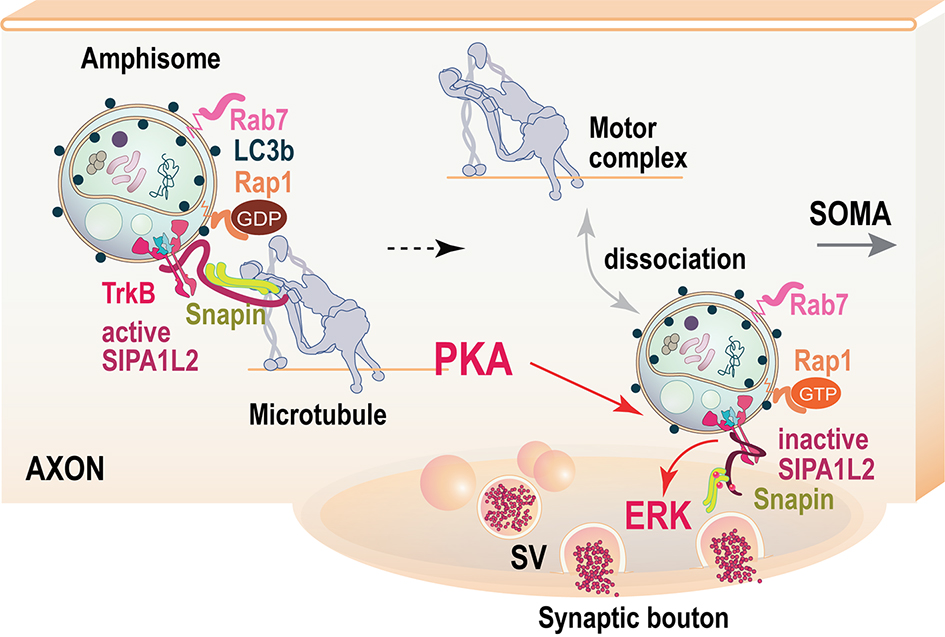
Amphisomes are hybrid organelles that result from the fusion of autophagosomes with late endosomes. In non-neuronal they are of transient nature and they rapidly undergo degradation. In previous work we found that in neurons amphisomes are endowed with signaling properties as a result of the incorporation of active TrkB receptors to autophagosomes. We showed that trafficking and signaling capabilities of amphisomes are controlled by SIPA1L2, a RapGAP protein that serves as a link to the dynein motor complex via its interaction with Snapin, and that it also regulates TrkB downstream signaling via Rap1 and ultimately ERK activation. Both features are regulated in a PKA-dependent manner, as PKA phosphorylation causes the stopover of the organelles at presynapses and the termination of SIPA1L2 RapGAP activity which enables ERK activation at boutons. During Syntophagy’s first funding period we investigated how amphisomes are formed in neurons and the mechanisms leading to amphisome biogenesis. It turned out that amphisomes come to existence after synaptogenesis and that synaptic activity is the main driver for their biogenesis. Accordingly, we found that sustained synaptic stimulation causes the recruitment of autophagy proteins to boutons and the induction of synaptic autophagy at presynapses as well as amphisome biogenesis. Furthermore, our work revealed that bulk endosomes have an essential function as membrane donors supporting the formation of amphisomes, and that activation of AMPK at boutons is instrumental for amphisome biogenesis. Moreover, we showed that amphisome biogenesis regulates BDNF/TrkB-dependent local protein synthesis at boutons. Capitalizing on these findings, we will investigate which signaling mechanisms lead to the induction of synaptic autophagy, with particular focus on AMPK activation and downstream signaling and how this relates to the recruitment of autophagy proteins to the presynapse. Moreover, we aim to understand the role of bulk endosomes as membrane donors in amphisome formation and the role of the presynaptic scaffold Bassoon on activity-dependent synaptic autophagy and local protein synthesis. Finally, we will investigate how amphisomes regulate the synthesis and degradation of presynaptic proteins and how amphisomes control the local mitochondrial function by enabling the translation of mitochondrial proteins.
References:
Grochowska, K.M., Andres-Alonso, M., Karpova, A., and Kreutz, M.R. (2022). The needs of a synapse-How
local organelles serve synaptic proteostasis. EMBO J 41, e110057. 10.15252/embj.2021110057.
Karpova, A., Hiesinger, P.R., Kuijpers, M., Albrecht, A., Kirstein, J., Andres-Alonso, M., Biermeier, A.,
Eickholt, B.J., Mikhaylova, M., Maglione, M., et al. (2025). Neuronal autophagy in the control of synapse
function. Neuron 113, 974-990. 10.1016/j.neuron.2025.01.019.
Andres-Alonso, M., Ammar, M.R., Butnaru, I., Gomes, G.M., Acuna Sanhueza, G., Raman, R., Yuanxiang,
P., Borgmeyer, M., Lopez-Rojas, J., Raza, S.A., et al. (2019). SIPA1L2 controls trafficking and local
signaling of TrkB-containing amphisomes at presynaptic terminals. Nat Commun 10, 5448.
10.1038/s41467-019-13224-z.
Okerlund, N.D., Schneider, K., Leal-Ortiz, S., Montenegro-Venegas, C., Kim, S.A., Garner, L.C., Waites,
C.L., Gundelfinger, E.D., Reimer, R.J., and Garner, C.C. (2017). Bassoon Controls Presynaptic Autophagy
through Atg5. Neuron 93, 897-913 e897. 10.1016/j.neuron.2017.01.026.
Gundelfinger, E.D., Karpova, A., Pielot, R., Garner, C.C., and Kreutz, M.R. (2022). Organization of
Presynaptic Autophagy-Related Processes. Front Synaptic Neurosci 14, 829354.
10.3389/fnsyn.2022.829354.